- Contact us: office@woods.consulting

- Contact us: office@woods.consulting
- Customer Support
Enterprise Project Planning & Scheduling
Logic-driven schedules for capital projects, turnarounds and maintenance programs, planned on Microsoft Dynamics 365 and tied to the work in the field, with planners who can explain every date in them.
A schedule is only useful if people trust it
On many large projects the plan lives in a scheduling tool that only the planners can open, while cost, crews and progress sit in other systems. Dates move, nobody can say why, and every review turns into a debate about whose numbers are right.
We build schedules on real logic, calculate them with the critical path method, and keep them on the same Microsoft platform as your resources, costs and field work. Planning, delivery and finance then look at the same plan.
Capital projects, turnarounds and maintenance
How we take effort out of planning
On a capital project, much of the planning effort goes into keeping the schedule, the cost plan and the progress reports in step with each other. We take that work out in five places, on Microsoft Dynamics 365 and the Power Platform. Every engagement starts with a scoping workshop, and you get a written price for a fixed scope instead of an hourly estimate.
01
One plan, one platform
Schedule, resources, cost and progress live together in Dynamics 365 Project Operations, connected to SAP or your ERP instead of copied into spreadsheets. Planning, delivery and finance work from the same numbers.
02
The whole network, scheduled
Turnarounds and large capital projects run to thousands of activities. Our scheduling engine calculates the critical path across all of them, with calendars, lags, float and updates as of a status date.
03
Progress from the field
Crews and contractors work from Field Service work orders tied to the plan, so each update starts from what happened on site. Contractor cost is approved against the project before it becomes an invoice.
04
Portfolio reporting without the legwork
Power BI reports status, dates, cost and cash flow across your projects, so the portfolio overview for management no longer has to be assembled by hand.
05
Planners who can explain every date
WBS Academy teaches the method behind the dates: logic, the critical path, float, calendars, constraints and the update cycle. Most lessons end in a scheduling lab where your planners practice on a real network.
From the critical path to the crews in the field
Planning & Scheduling Services
Planning in Dynamics 365 Project Operations
Project Operations becomes the system of record for the plan: work breakdown structure, resources, time, cost and progress in one place, so planning, delivery and finance work from the same numbers.
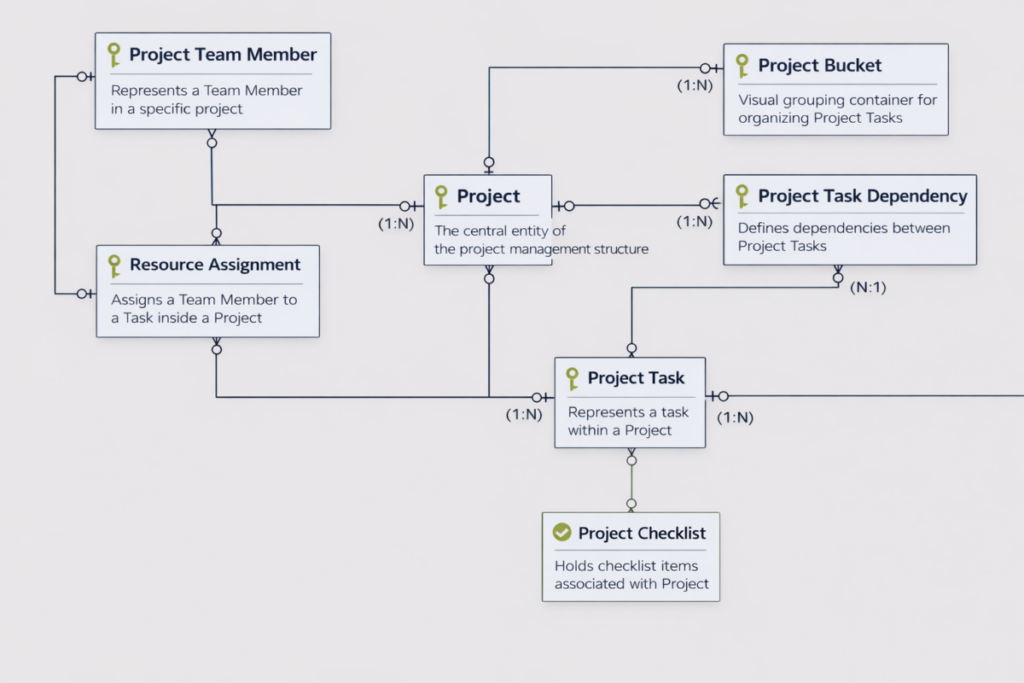
Critical path scheduling at scale
Dynamics 365 Project Operations can hand its scheduling to an external engine. We use that to give project organizations a real CPM schedule in Dataverse: dependencies with lags, forward and backward pass, float, calendars and work templates, and status-date scheduling that moves unfinished work forward with the status date.
Planners keep working in Project Operations, and the engine keeps the dates consistent, fast enough for plans with thousands of activities.

Turnarounds and maintenance work
A turnaround is the largest and most tightly constrained piece of work a process plant does: a fixed outage window, thousands of jobs and mostly contractor crews. We map it onto Dynamics 365 Project Operations and Field Service.
Work orders created in your maintenance or ERP systems come in through integration, are scheduled into the plan and go out to Field Service crews, in one model that operations, maintenance and finance can all see.

Planning skills for your team
Most planners learn scheduling by learning a tool, which shows them where the buttons are but not why the dates land where they do. WBS Academy starts with the method.
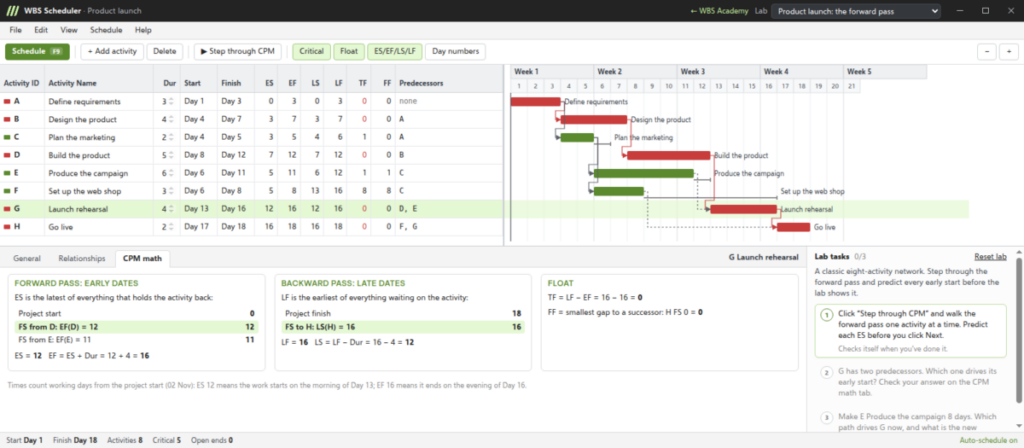
Three courses are live: Scheduling Fundamentals, Constraints and Calendars, and Updating and Progressing a Schedule. Between them they cover dependencies, the critical path and float, calendars and constraints, and the update cycle with the status date, baselines and variance. Most lessons end in the WBS Scheduler, a desktop-style scheduling lab that runs in the browser and shows its working.
Who you work with
Zachary Woods
Zachary Woods founded Woods Business Solutions. He is a US Army veteran with more than 15 years as a systems integrator in Microsoft business applications, and he specializes in large Project Operations and Field Service implementations for oil and gas, energy and industrial operators.
He has worked on large-scale maintenance and turnaround projects with Marathon Petroleum (MPC), at a scale where the standard scheduling engine had to be replaced. He wrote our seven-part series on building an external scheduling engine for Project Operations, which covers the data model, working time, the critical path, status-date scheduling and performance at scale. He also built WBS Academy and its scheduling lab.
Further reading
Building an external scheduling engine for D365 Project Operations
Part 1: the WBS data model.
Dependencies and the critical path
Part 5 of the series: forward pass, backward pass, float, and what the due date anchors.
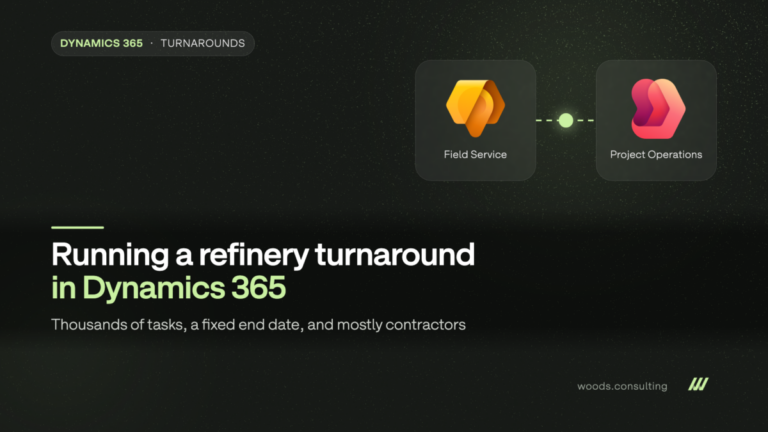
Running a refinery turnaround in Dynamics 365
Thousands of tasks, a fixed end date, and mostly contractors.
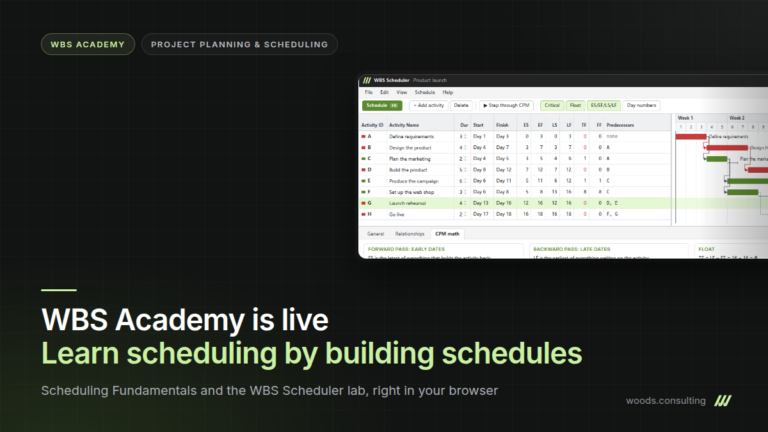
WBS Academy is live
Learn scheduling by building schedules, in a scheduling lab that runs in the browser.